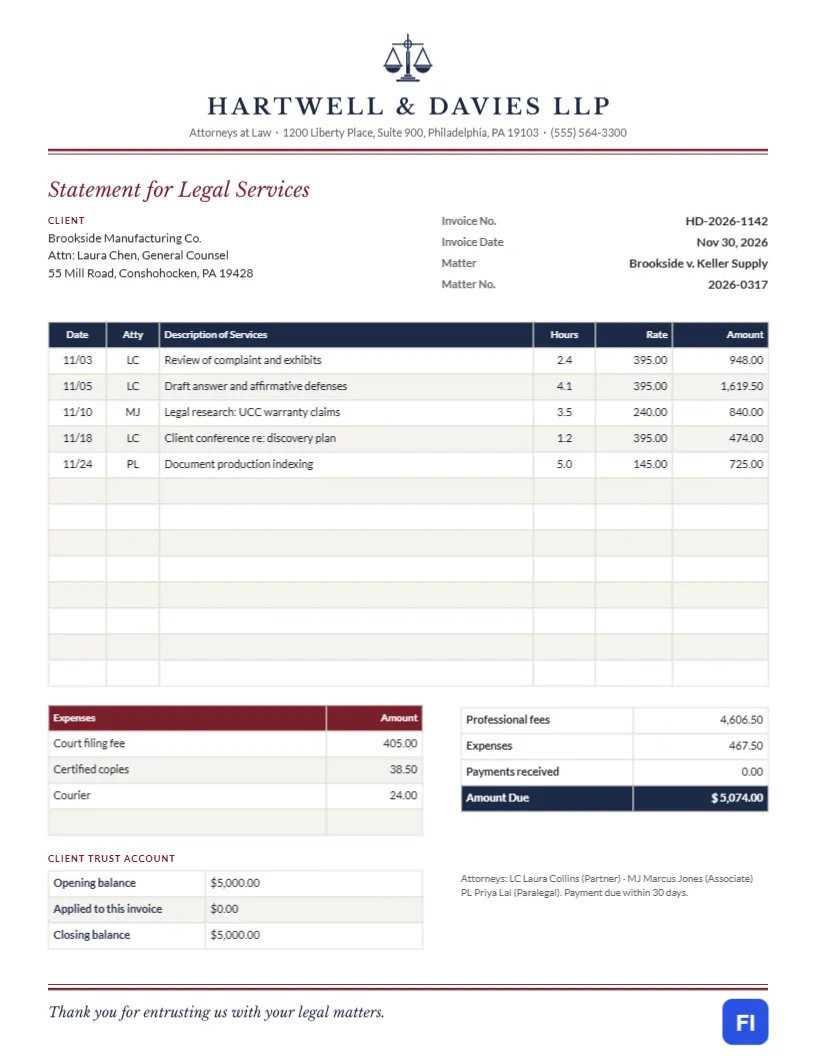
Clients who receive a legal bill read it closely. They want to see who worked on their matter, on which days, for how long, and on what. Bar rules in many jurisdictions also require bills to be clear and to account for money held in trust. A law firm’s invoice must therefore be detailed, orderly and dignified. This legal services invoice template is laid out as a traditional statement for legal services, with dated time entries, a costs table and a client trust account summary beneath a classic centred letterhead.
For Law Firms and Solo Practitioners
The template suits small and mid-sized law firms, solo attorneys, mediators, paralegal services, immigration consultants and other professionals who bill detailed time. The sample shows Hartwell & Davies LLP billing Brookside Manufacturing Co. for November work on the matter Brookside v. Keller Supply: reviewing a complaint, drafting an answer, legal research on UCC warranty claims, a client conference on discovery and document production indexing, plus a court filing fee, certified copies and a courier.
A Classic Letterhead in Navy and Burgundy
At the top centre of the page sits a navy scales of justice icon. Beneath it, the firm’s name, HARTWELL & DAVIES LLP, is set in widely spaced Libre Baskerville capitals, with Attorneys at Law, the address and the phone number in small grey type. A double burgundy rule, one thick line over one fine line, separates the letterhead from the statement, and the same double rule reappears near the bottom of the page, framing the document like formal stationery.
Statement for Legal Services follows in burgundy italic. The client block names the company, the general counsel, and the address; the invoice number, date, matter name, and matter number line up on the right. The time entries table has six columns: Date, Atty (the timekeeper’s initials), Description of Services, Hours, Rate, and Amount. Under it sits an Expenses table with a burgundy header, a totals table (professional fees, expenses, payments received, and a navy Amount Due), a Client Trust Account summary, and a key to the timekeepers’ initials. A closing line thanks the client for entrusting the firm with their legal matters.
Timekeepers, Roles and Rates
Legal bills list work by timekeeper, and clients expect to know who each set of initials belongs to and what they cost. The sample uses this staffing, which the key at the bottom of the invoice explains:
| Initials | Timekeeper | Role | Hourly Rate |
|---|---|---|---|
| LC | Laura Collins | Partner | $395 |
| MJ | Marcus Jones | Associate | $240 |
| PL | Priya Lal | Paralegal | $145 |
Delegating research and document work to associates and paralegals at lower rates, and showing it clearly, is one of the best ways to demonstrate value to a cost-conscious client.
Writing Good Time Entry Narratives
Each description should say what was done and why, in enough detail to justify the time without revealing privileged strategy. Draft answer and affirmative defenses are specific; Work on file is not. Avoid block billing, where several tasks are lumped into one long entry, because many clients and courts reject it. Record time in tenths of an hour, as the sample does.
Costs Advanced and Disbursements
Out-of-pocket costs such as filing fees, certified copies, courier charges, deposition transcripts, and expert fees belong in the Expenses table, separate from professional fees. List them at cost unless your engagement letter allows a markup. The sample shows $467.50 in expenses alongside $4,606.50 in fees, for an amount due of $5,074.00.
The Client Trust Account Summary
Where a client has paid a retainer into your trust (IOLTA) account, the invoice should show the opening balance, any amount applied to this bill, and the closing balance. In the sample, a $5,000 retainer is held, and nothing is applied, so the full invoice is payable directly. If your practice applies trust funds automatically, enter the amount applied and reduce the amount due accordingly, following your jurisdiction’s trust accounting rules.
Editing Entries and Totals
The time entries, expenses, totals, and trust summary are all editor tables. Double-click them to type, or open Edit Table Data, and use + Add Row and – Remove Last to fit the month’s work. Many practice management systems export time entries as CSV, which Import CSV can bring in directly. The cells hold text, not calculations, so multiply each entry’s hours by its rate, total the fees and expenses, and update the amount due yourself.
Firm Branding and Paper
The scales icon is an editable vector: recolour it, or replace it with your firm’s logo image if you have one. Change the firm name, address, and the burgundy accent to match your letterhead. The template is US Letter, 8.5 by 11 inches. Send it as a PDF; for clients who expect printed statements, use a heavier cream or white bond paper to match your stationery.
Payment Terms and Engagement Letters
The key at the bottom of the page states that payment is due within thirty days. Keep your invoice terms consistent with your engagement letter, including any interest on late balances and whether fees for unpaid invoices may be deducted from trust. Clear, consistent terms protect the firm and reduce fee disputes.
Handling Fee Questions From In-House Counsel
General counsel often review outside counsel bills against their company’s billing guidelines, which may cap rates, limit the number of attorneys at a meeting, or exclude certain tasks such as internal conferences. Read those guidelines before the first invoice and follow them in your entries. When a client queries a line, respond promptly with the underlying detail and, where appropriate, offer a small write-down; a quick, cooperative answer preserves a relationship worth far more than one disputed entry.
Legal Invoice FAQs
Can I bill a flat fee with this template?
Yes. Use one entry such as Flat fee: will and trust package with a quantity of 1.
How do I show a courtesy discount?
Add a row to the totals table such as Courtesy discount with a negative amount before the Amount Due.
Should privileged details appear in descriptions?
Keep descriptions factual and general enough that the bill would not reveal strategy if it were ever disclosed.