Every business eventually has a customer who does not pay on time. The first reminder is often a friendly email; when that does not work, a formal past-due notice usually does. It should be firm but polite, show exactly which invoices are outstanding and for how long, and make paying easy. This Past-Due Invoice Template is designed for that moment: a red corner banner, an OVERDUE stamp, and an aging summary that makes the account’s status impossible to overlook.
Who Sends Past Due Notices
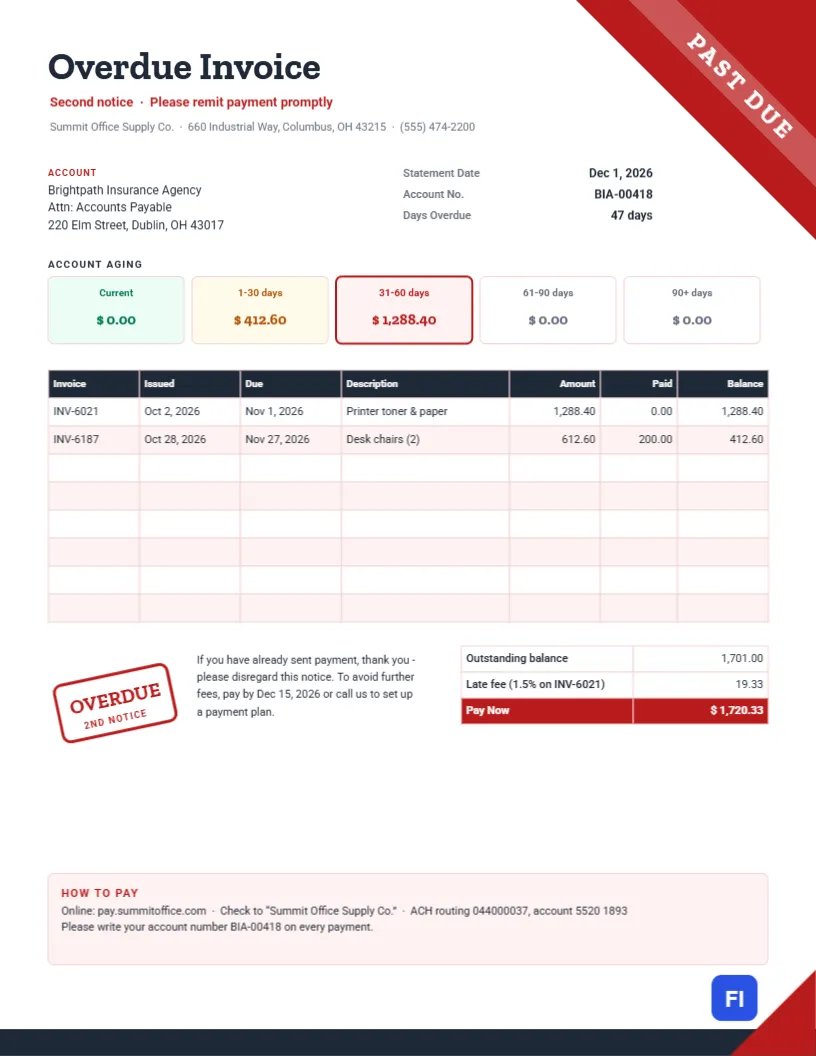
Any business that offers payment terms will need one: wholesalers and suppliers, service companies with monthly accounts, landlords, contractors, agencies and freelancers. The sample shows Summit Office Supply Co. sending a second notice to Brightpath Insurance Agency, which has two open invoices, one for printer toner and paper and one, partly paid, for two desk chairs.
Red Banner, Rubber Stamp and Aging Cards
A bold red triangle fills the top-right corner of the page, with a lighter diagonal stripe across it and the words PAST DUE running along the diagonal in white Zilla Slab capitals. It is the first thing the reader sees. Overdue Invoice is set large in dark slate on the left, with Second notice · Please remit payment promptly in red and the supplier’s address and phone below.
Under the account block and facts (statement date, account number, and days overdue), five aging cards line up across the page: Current, 1-30 days, 31-60 days, 61-90 days, and 90+ days. Each shows the amount in that bucket, tinted green, amber, red, or neutral, and the 31-60 day card, where most of this balance sits, has a thicker red border. A table of open invoices lists invoice number, dates, description, amount, paid, and balance. Next to the totals, a red rubber stamp reading OVERDUE · 2ND NOTICE sits at an angle beside a short, courteous message. A How to pay box runs across the page, and a slate footer band with a red corner echoes the banner.
An Escalation Timeline That Stays Professional
Collecting late payments works best with a consistent sequence. Here is a timeline many small businesses follow:
| Days After Due Date | Action | Tone |
|---|---|---|
| 1-3 | Friendly email reminder with the invoice attached | Assume it was missed |
| 10-14 | Past due notice (first notice) and a phone call | Polite and clear |
| 30 | Second notice with late fee applied, like this sample | Firm |
| 45-60 | Final notice; pause further credit or work | Formal |
| 90+ | Collection agency or small claims, if worthwhile | Last resort |
Adjust the timing to your terms and relationships; a long-standing customer with a temporary problem may need a payment plan more than a stern letter.
Reading the Aging Buckets
Aging shows how long each unpaid amount has been outstanding. In the sample, $412.60 is 1–30 days past due and $1,288.40 is 31- 60 days past due, for an outstanding balance of $1,701.00. The older the debt, the harder it is to collect, which is why the design draws the eye to the oldest bucket with a balance. Update the amounts and move the red border to the oldest non-zero bucket each time you send a notice.
Late Fees
Only charge late fees your original terms allowed, and state how they are calculated. The sample applies 1.5% to the oldest invoice, adding $19.33, for a total of $1,720.33. Check local law, because some places limit late fees or interest on commercial accounts. Waiving the fee for a customer who pays promptly after the notice is a useful goodwill gesture.
The Message Beside the Stamp
The short message beside the stamp does three things: thanks the customer if payment is already on its way, gives a firm new deadline, and offers a payment plan. That combination keeps the relationship intact while making clear the account needs attention. Avoid threats or emotional language on the first and second notices.
Editing Open Invoices and Totals
The open invoices table and the totals are editor tables. Double-click to edit or open Edit Table Data; add a row for each unpaid invoice with + Add Row and trim with – Remove Last. The aging amounts are text on the cards, so update them by hand. Nothing recalculates automatically, so check that the aging cards, the table balances and the outstanding balance all agree.
Customizing the Banner and Stamp
The corner banner is grouped, and its PAST DUE text is a separate rotated text box, so you can change it to FINAL NOTICE or SECOND NOTICE. The OVERDUE stamp is a rotated outline with two lines of text; edit them for FINAL NOTICE or delete the stamp for a softer first reminder.
Sending the Notice
The page is US Letter, 8.5 x 11 inches. Email it as a PDF to the accounts payable contact and, for larger balances, also post a printed copy; a letter in the mail often gets attention that an email does not. Keep a copy of every notice you send, with dates, in case the debt ever needs to go further.
Keeping Good Customers While Collecting
Most overdue accounts belong to good customers going through a busy or difficult patch. A phone call alongside the notice, asking whether anything is wrong with the order or the invoice, often uncovers a simple problem, like a missing purchase order number or an approval stuck with someone on holiday. Solving that problem gets you paid and keeps the customer.
Payment Plans
When a customer genuinely cannot pay the full balance at once, a written payment plan often recovers more than pressure does. Agree the instalment amounts and dates, confirm them in writing, and send a short statement after each payment showing the remaining balance. Keep the late fee on hold while the plan is honoured, and reinstate it only if payments stop.
Past Due Invoice FAQs
Can I send this for a single invoice?
Yes. Leave one row in the open invoices table and put the full amount in the matching aging card.
Should I stop work for overdue customers?
It is common to pause new orders once an account is significantly overdue. Say so in your terms, not as a surprise.
Is the red too aggressive for a first reminder?
For a gentle first reminder, change the red to amber and remove the stamp; keep the red for later notices.