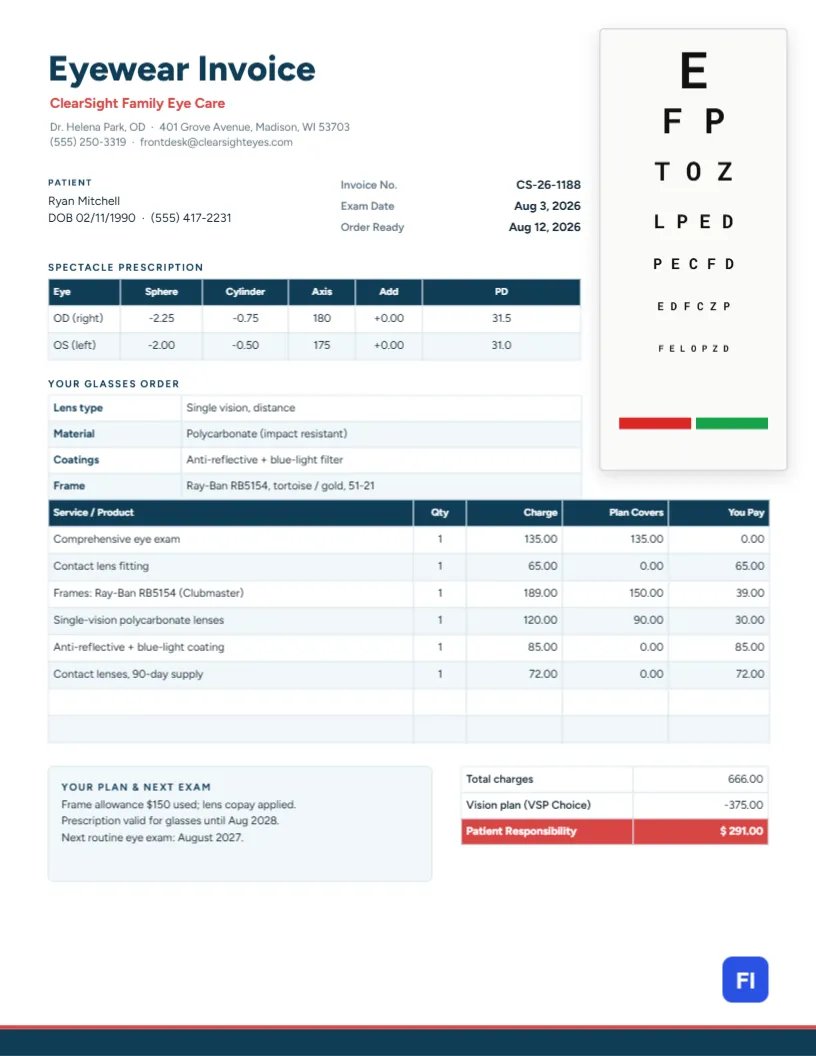
A visit to the optometrist often ends with two things: a new prescription and a new pair of glasses. Patients want to see what their vision plan covered, what they owe, and a copy of the prescription they can keep. This Optometry and Eyewear Invoice Template brings all three together, with the most familiar image in eye care, a Snellen eye chart with letters shrinking line by line, running down the right-hand side of the page.
Optometrists, Opticians and Eyewear Shops
It suits independent optometry practices, opticians and optical shops, eyewear boutiques, and optometrists working inside retail stores. The sample shows ClearSight Family Eye Care invoicing a patient for a comprehensive eye exam, a contact lens fitting, designer frames, single-vision lenses with coatings, and a three-month supply of contact lenses.
An Eye Chart Beside the Invoice
A tall, slightly shaded card on the right holds the eye chart: a large E at the top, then F P, T O Z, L P E D and progressively smaller rows, set in a bold monospaced font like a real chart. Beneath the letters sit the red and green bars used in the duochrome test. On the left, Eyewear Invoice is set in bold navy Figtree, with the practice name in red and the doctor, address, and contact details beneath.
The patient block and invoice facts are followed by the spectacle prescription table, with sphere, cylinder, axis, add, and pupillary distance for each eye. A glasses order table records lens type, material, coatings, and frame. The charges table shows each item’s charge, what the vision plan covers, and what the patient pays, followed by plan notes and the totals.
How to Read the Prescription Table
Patients often ask what the numbers mean. This guide explains each column:
| Term | Meaning |
|---|---|
| OD/OS | Right eye (oculus dexter)/left eye (oculus sinister) |
| Sphere | Main lens power; minus for short-sighted, plus for long-sighted |
| Cylinder | Extra power to correct astigmatism |
| Axis | The angle of the astigmatism correction, 1 to 180 degrees |
| Add | Extra reading power for bifocal or progressive lenses |
| PD | Pupillary distance, used to centre the lenses |
Vision Plan Coverage in Plain Numbers
The charges table has a Plan Covers column so patients can see their benefits line by line. In the sample, the plan covers the exam in full, $150 of the frame allowance, and $90 of the lenses. Contact lens fitting, the lens coatings, and the contact lens supply are not covered. Charges total $666.00, the plan pays $375.00, and the patient’s responsibility is $291.00.
Glasses Order Details
The glasses order table records exactly what was ordered: single-vision distance lenses in impact-resistant polycarbonate, anti-reflective and blue-light coatings, and the frame model, colour, and size. It is useful if the glasses need to be remade, and it answers the patient’s question about what they paid for.
Editing the Prescription and Charges
The prescription, order details, charges, and totals are editor tables. Double-click them or use Edit Table Data to enter each patient’s values, and change the number of charge lines with + Add Row and – Remove Last. The figures are typed rather than calculated, so check the covered amounts against the plan’s authorisation and total the patient’s share by hand.
Prescription Validity and Next Exam
Spectacle prescriptions are usually valid for one or two years, depending on local rules and the patient’s age. The plan box notes that the prescription is valid for glasses until August 2028 and that the next routine exam is due in a year. Patients who need to order glasses elsewhere are entitled to a copy of their prescription in many places; this invoice doubles as that copy.
Changing the Eye Chart
The eye chart letters are ordinary text in rows, so you can change them, remove rows, or recolour them. The card behind them can take a different background. Navy and red suit a medical practice; an eyewear boutique might prefer black and gold with a more fashion-led title font.
Printing for the Patient
This invoice is set up for US Letter paper. Print it at checkout when the glasses are ordered, and give the patient a copy with their prescription. Email the PDF for their records and for any flexible spending account claim.
Contact Lens Prescriptions
Contact lens prescriptions include extra details such as base curve, diameter, and lens brand, and are written after a fitting. If you fit contacts, add a second prescription table for contact lenses, or give the patient a separate contact lens prescription alongside this invoice.
Remakes, Adjustments and Warranties
Most practices remake lenses free if the prescription changes within a set period, and adjust frames at no charge. State your warranty and remake policy in the plan box or on your website, and record any remake on the patient’s file with a zero-cost line so the history is complete.
FSA and HSA Payments
Eye exams, prescription glasses and contact lenses are generally eligible medical expenses for flexible spending and health savings accounts. Patients need an itemised invoice showing the provider, date of service, and amounts paid, all of which appear on this template. Non-prescription sunglasses usually are not eligible, so list them separately.
Medical Eye Visits vs Routine Exams
Vision plans usually cover routine eye exams, glasses, and contacts. Medical eye problems, such as an eye infection, dry eye treatment, or glaucoma monitoring, are often billed to the patient’s medical insurance instead. Explaining which plan paid for which visit on the invoice prevents confusion when patients receive statements from two insurers.
Eyewear Invoice FAQs
Can I use this for a second pair or sunglasses?
Yes. Add each pair’s frame and lenses as extra lines, note any second-pair discount, and show what the plan covers for each.
Where do I record a progressive lens?
Enter the add power in the prescription table and describe the lens type in the order details.
Can I include a children’s eye exam?
Yes. Many plans cover pediatric exams and glasses differently; show the plan amounts line by line.