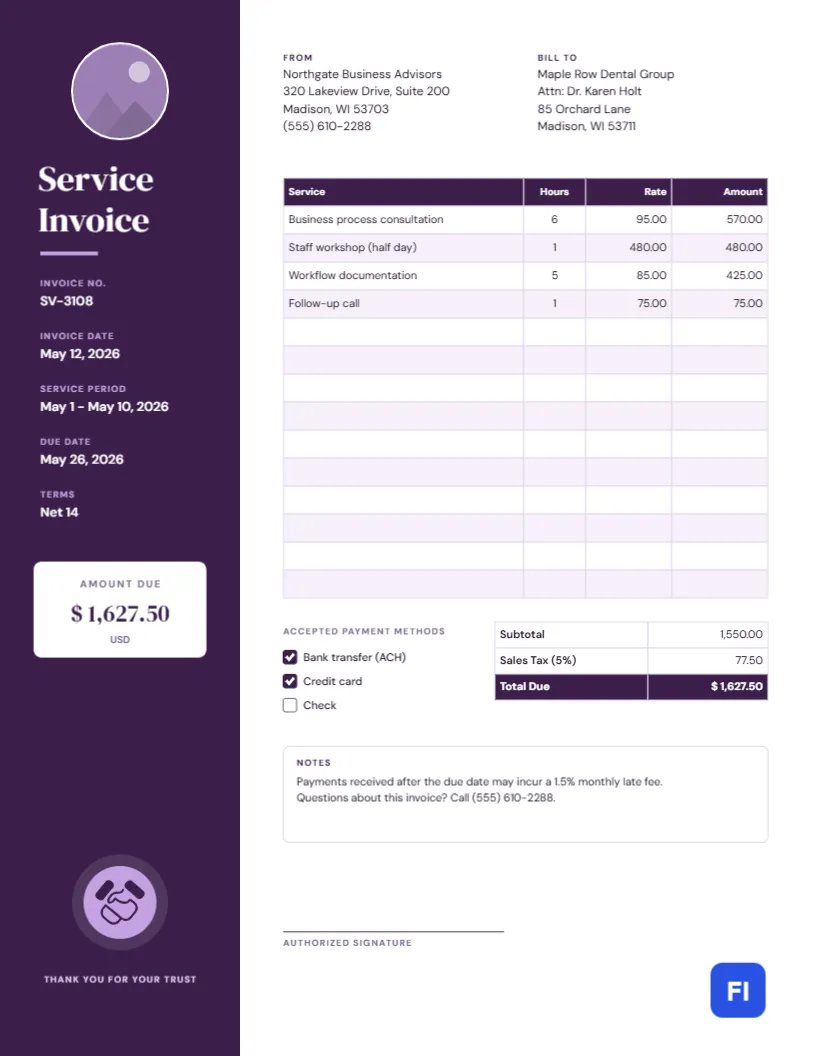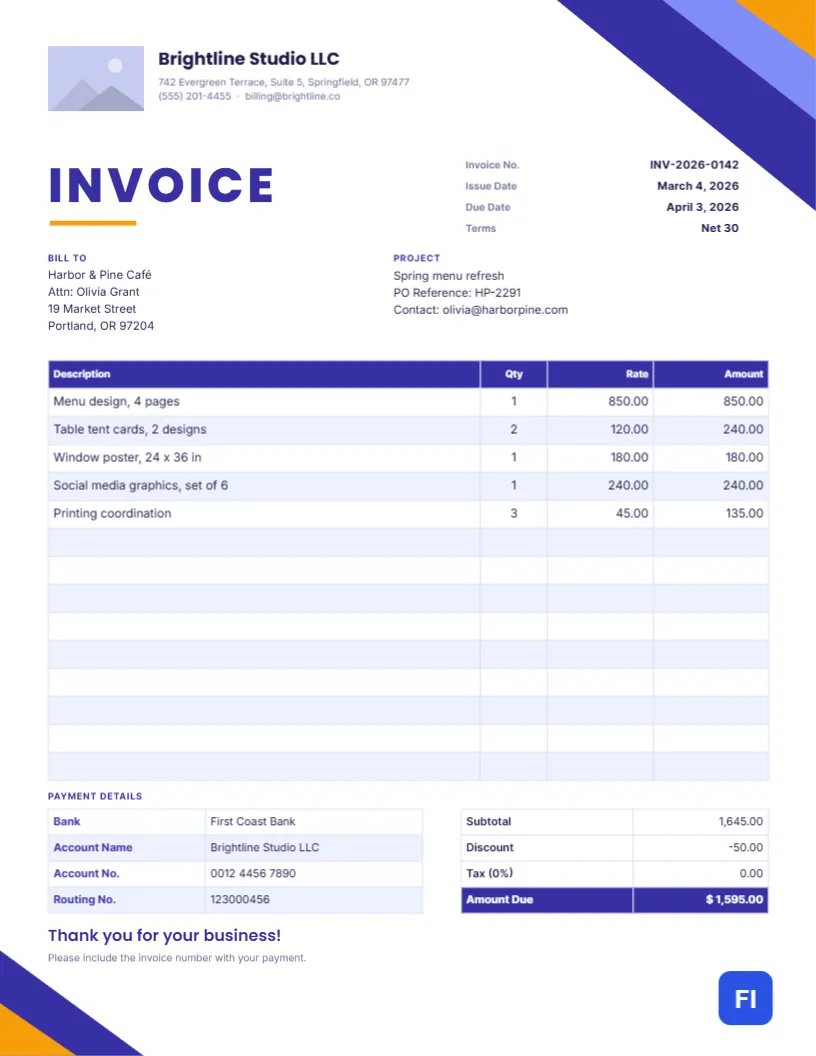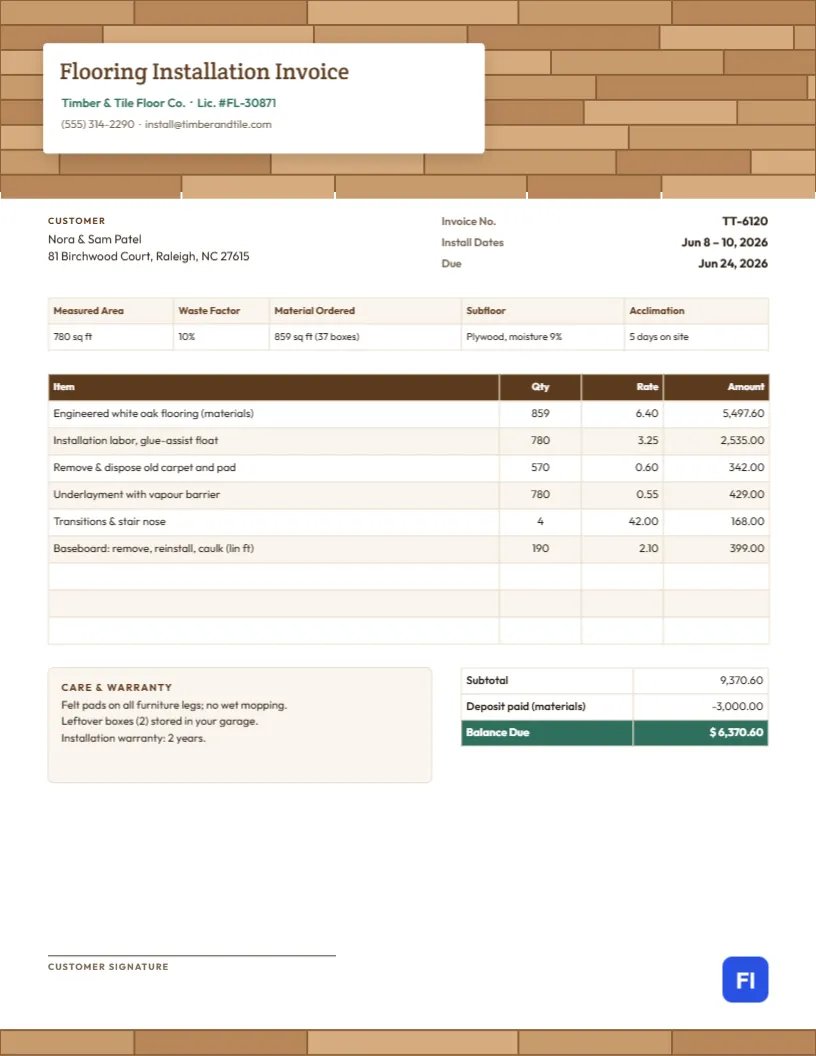
A new floor is priced from a few key numbers: how many square feet were measured, how much extra material was ordered to allow for cuts and waste, and the rates for materials and labor. Customers who see those numbers understand why they bought more boxes than their rooms seem to need. This Flooring Installation Invoice Template puts them up front, below a header laid in staggered oak planks just like a freshly installed floor.
Flooring Installers and Floor Stores
It suits hardwood, engineered wood, laminate, vinyl plank, and tile installers, flooring stores with installation crews, remodels who install floors, and refinishing companies. The sample shows Timber & Tile Floor Co. invoicing a couple for engineered white oak in their living and dining room, kitchen, and hallway, with carpet removal, underlay, transitions, and baseboard work.
Planks Across the Header
The header is covered in horizontal wood planks in three warm oak tones, each row offset so the end joints never line up, exactly how a well-laid floor looks. Plank lengths vary so the pattern feels natural. A white card with a shadow sits on the planks, carrying Flooring Installation Invoice in brown Crete Round, the company name and license in green, and the contact line. A single row of planks forms the footer.
The customer block and the invoice number, installation dates, and due date follow. A strip records the measured area, waste factor, material ordered, sub-floor condition, and acclimation time. The items table, care and warranty notes, the totals and a signature line complete the page.
Understanding the Waste Factor
Every floor loses material to cuts at walls, doorways, and around cabinets, plus the occasional damaged board. Installers add a waste factor when ordering. Typical allowances:
| Layout | Typical waste factor |
|---|---|
| Straight lay, simple rectangular rooms | 5- 10% |
| Rooms with many corners, closets, and doorways | 10-12% |
| Diagonal layout | 15% |
| Herringbone or chevron patterns | 15-20% |
The sample measures 780 square feet and applies 10%, so 859 square feet (37 boxes) were ordered.
Materials, Labor and Extras
Materials are billed on the quantity ordered ($6.40 per square foot), while labor is billed on the measured area ($3.25). Removing and disposing of 570 square feet of old carpet, underlay with a vapor barrier, four transitions and stair nose, and removing, reinstalling, and caulking 190 linear feet of baseboard complete the job for $9,370.60. The $3,000 materials deposit is credited, leaving $6,370.60.
Acclimation and Sub-floor Checks
Wood flooring expands and contracts with humidity, so boards should sit in the home for several days before installation. The strip records five days of acclimation and a subfloor moisture reading of 9%, which shows the job was done to the manufacturer’s instructions and protects the warranty if gaps or cupping appear later.
Editing the Measurements and Items
The measurement strip, items table, and totals are editor tables. Double-click to type in them or use Edit Table Data, and change the number of lines with + Add Row and – Remove Last. Quantities and rates are typed values, so multiply them out and update the totals yourself.
Leftover Boxes Are Valuable
Encourage customers to keep leftover boxes, as the care note does. If a board is damaged years later, matching flooring from the same production run is often impossible to buy. Two spare boxes stored in the garage can save a whole room from being replaced.
Care and Warranty Notes
New floors need a little care: felt pads on furniture legs, no wet mopping on wood, and mats at exterior doors. Write the essentials and your installation warranty on the invoice, and hand over the manufacturer’s care guide. The sample offers a two-year installation warranty on top of the manufacturer’s product warranty.
Changing the Wood Tones
The planks are grouped, so the whole floor recolors together. Switch to gray-washed tones for a modern look, deep walnut for a traditional one, or light maple for a Scandinavian style. For a tile company, replace the planks with a grid of squares in the same way.
Printing at Project Completion
The template uses letter-size paper. Walk the finished floor with the customer, note any small touch-ups, then have them sign the printed invoice and email the PDF for their records and home insurance file.
Stairs, Molding and Floor Transitions
Stairs are priced per step because each tread and riser takes time to cut and fit. Transitions between rooms and different floor heights are priced per piece. Listing them separately, rather than adding them into the square-foot rate, keeps your pricing fair when rooms have many doorways.
Tile and Vinyl Plank Jobs
For tile, add thinset, grout, backer board, and any heated-floor mats as separate lines, and adjust the waste factor for your pattern. For luxury vinyl plank, underlay may be built in and acclimation shorter; update the strip to match the product’s instructions.
Deposits for Special-Order Flooring
Flooring is usually ordered specifically for each job, often in a particular color and production run, and it can rarely be returned once delivered. That is why many installers take a materials deposit, as the sample does, before placing the order. Credit the deposit on the final invoice and state on the quote that special-order materials are non-refundable once ordered, so customers understand before they sign.
Scheduling Around Other Trades
Floors are usually one of the last jobs in a remodel, after painting and cabinet work but before baseboards and appliances. Coordinate dates with the other trades and record the install dates on the invoice. If you have to return because another trade damaged the new floor, bill the repair to whoever is responsible, with photos, on a separate invoice.
Flooring Invoice FAQs
Should I charge for moving furniture?
Many installers do; list it as a line or include it in labor and say so in the quote.
Can I bill a customer-supplied floor?
Yes. Remove the materials line and bill labor and supplies only.
Why is the ordered area larger than the measured area?
Because of the waste factor for cuts and damaged boards, as explained in the measurement strip.