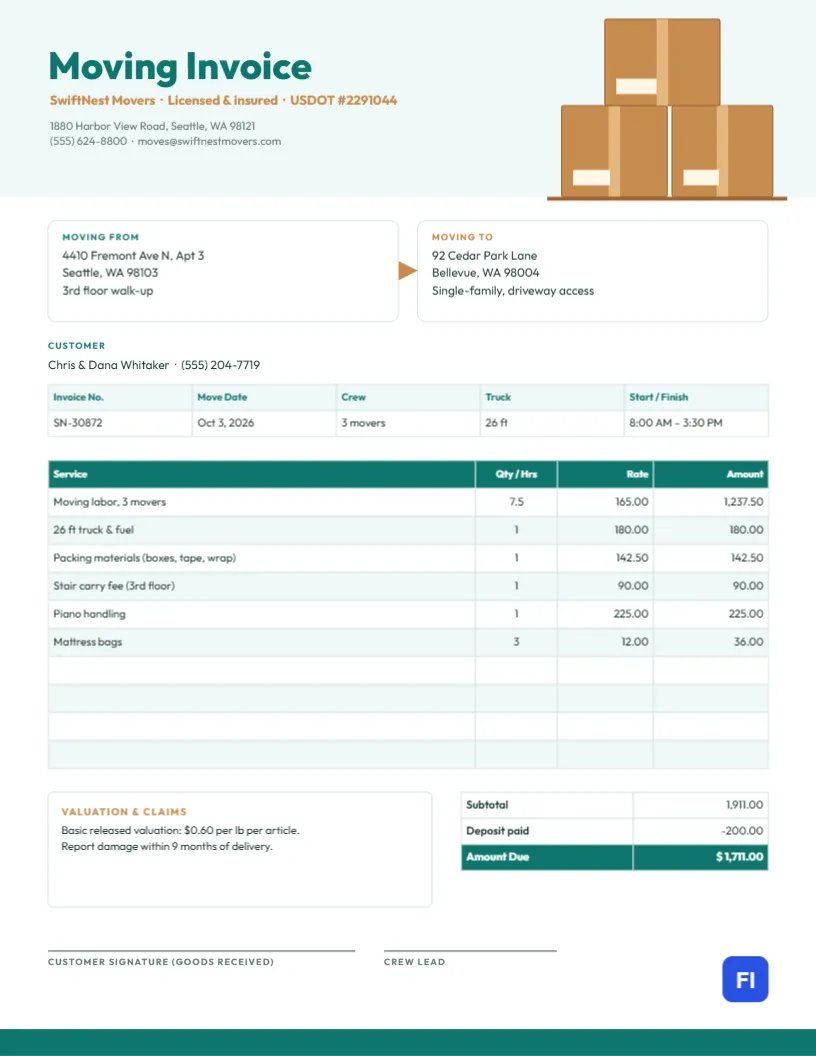
Moving day is stressful, and the bill at the end of it should not add to the stress. Customers want to see how many hours the crew worked, what the truck and materials cost, and what extra charges, such as stairs or a piano, were added. This Moving Company Invoice Template lays that out clearly, with a friendly design built around a stack of cardboard boxes and two address cards that show where the move started and ended.
Local Movers, Labor-Only Crews and Delivery Services
It suits local moving companies, labor-only loading crews, junk removal and delivery services, piano movers, student movers, and small businesses that move offices. The sample shows SwiftNest Movers billing Chris and Dana Whitaker for a move from a third-floor walk-up in Seattle to a house in Bellevue, with three movers for seven and a half hours, a 26-foot truck, packing materials, a stair fee, piano handling, and mattress bags.
Boxes, Teal and Two Address Cards
A pale teal header fills the top of the page. On its right, three cardboard boxes are stacked, two on the floor and one on top, each with a lighter strip of packing tape down the middle and a white label, sitting on a thin brown floor line. On the left, Moving Invoice is set in heavy teal Outfit, with the company name, license, and USDOT number in warm cardboard brown, and the address, phone, and email in grey.
Two rounded white cards sit side by side below the header: Moving From and Moving To, each with the full address and a note on access, such as 3rd floor walk-up or Single-family, driveway access. A small brown arrow between them points from origin to destination. The customer line, a strip for invoice number, move date, crew, truck size, and start and finish times, the services table, and the totals follow. A Valuation & Claims note sits beside the totals, and signature lines for the customer and crew lead sit above a teal footer band.
A Moving-Day Checklist to Send With the Invoice
Many movers email the invoice with a short checklist so customers can confirm nothing was missed:
- Walk through every room, closet, attic, and garage at the old address before the truck leaves.
- Check that all furniture was reassembled and beds set up where requested.
- Look over furniture and floors for any damage and note it on the paperwork before signing.
- Confirm the number of boxes delivered matches the number loaded, if an inventory was taken.
- Keep this invoice with your moving records; you will need it for any claim.
How Local Moves Are Usually Priced
Local moves are usually billed by the hour for the crew, often with a minimum of two or three hours, plus a truck fee and materials. Long-distance moves are more often priced by weight or volume. Extras include stair carries, long carries from the truck to the door, heavy items like pianos and safes, and packing services. The sample’s labor, truck, materials, and extras total $1,911.00, and after a $200 deposit, $1,711.00 is due.
Valuation, Not Insurance
Movers in the United States offer valuation coverage rather than insurance. Basic released value, often $0.60 per pound per item, is included at no extra cost but pays very little for a damaged item. Full value protection costs more. The invoice’s Valuation & Claims box states the level of coverage and how long the customer has to report damage. Stating it on the invoice, as well as the contract, avoids disputes.
Editing the Address Cards and Details
The address cards are text on rounded shapes, so type in the new addresses and access notes. The move details strip, services, and totals are editor tables: double-click them or use Edit Table Data, adding lines with + Add Row and removing them with – Remove Last. The cells hold typed values, so calculate labor hours times rate, add the truck, materials, and extras, subtract the deposit, and type in the totals yourself.
Start and Finish Times
For hourly moves, record when the crew started and finished, as the strip does with 8:00 AM to 3:30 PM. Some companies include drive time from the depot; if you do, say so. Having the times on the invoice, signed by the customer, prevents disagreements about how long the move took.
Changing the Boxes and Colors
The box stack is grouped, so it moves and scales together. Recolor the boxes, tape, and floor line if your brand uses different tones. The teal can become navy or orange to match your trucks. Update the company name and license numbers, and the invoice is ready for your crew leads.
Signing at the New Home
The page is US Letter, 8.5 by 11 inches. Many crews fill in the invoice on a tablet and have the customer sign on screen; others carry printed copies on a clipboard. Either way, get the customer’s signature to confirm the goods were received, and email a PDF copy before the crew leaves.
Tips, Payment and Reviews
Customers often ask whether they should tip the crew. If you allow card tips, add a Tip row to the totals; otherwise, a line in your email saying tips are welcome but never expected is enough. Ask for a review in the same message while the move is still fresh; a smooth move and a clear invoice are what customers remember.
Storage and Two-Stage Moves
When a move includes a stop at a storage unit, or goods are held in your warehouse for a few weeks, add each leg as its own line with its date and the monthly storage charge on a separate row. Issue the first invoice after the pickup and a second when the goods are delivered, so the customer pays for work already done and the balance follows on completion.
Moving Invoice FAQs
Can I use this for a long-distance move?
Yes. Replace the hourly labor line with a weight-based or flat-rate line and add fuel and tolls.
How do I bill a minimum charge?
If the move took less than your minimum, bill the minimum hours and note the 3-hour minimum in the description.
Where do I record damage?
Note any damage in the Valuation & Claims box before the customer signs, and start the claims process from there.