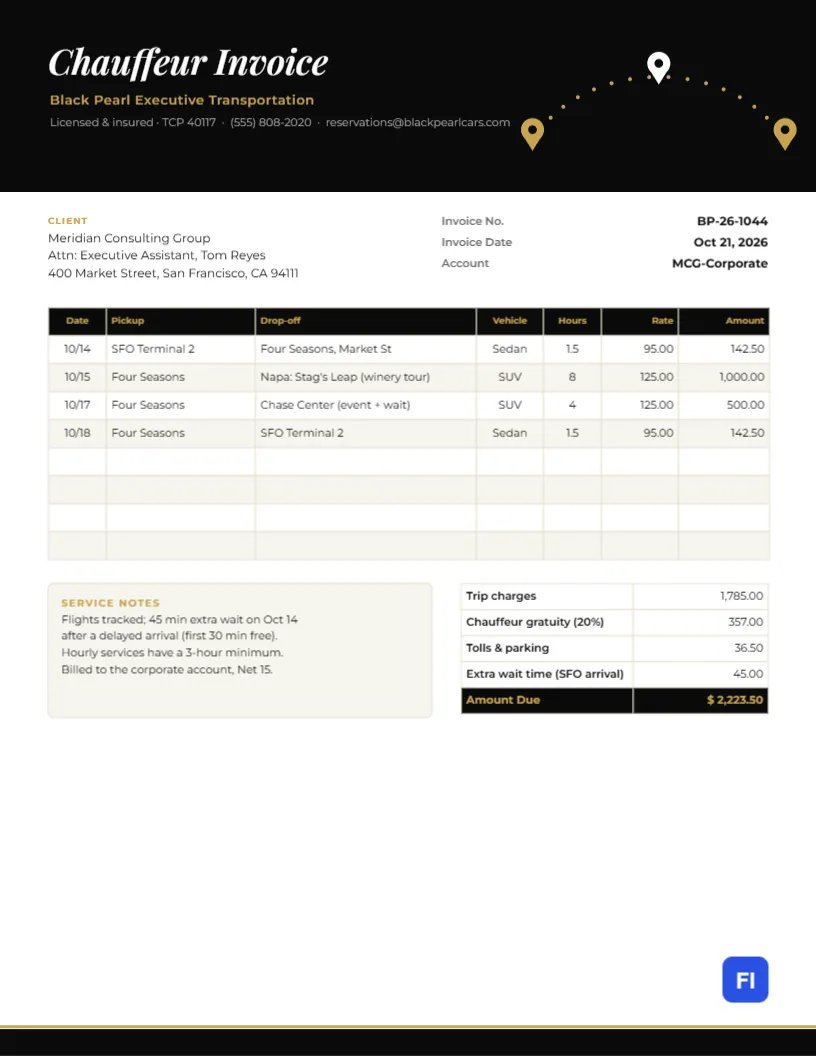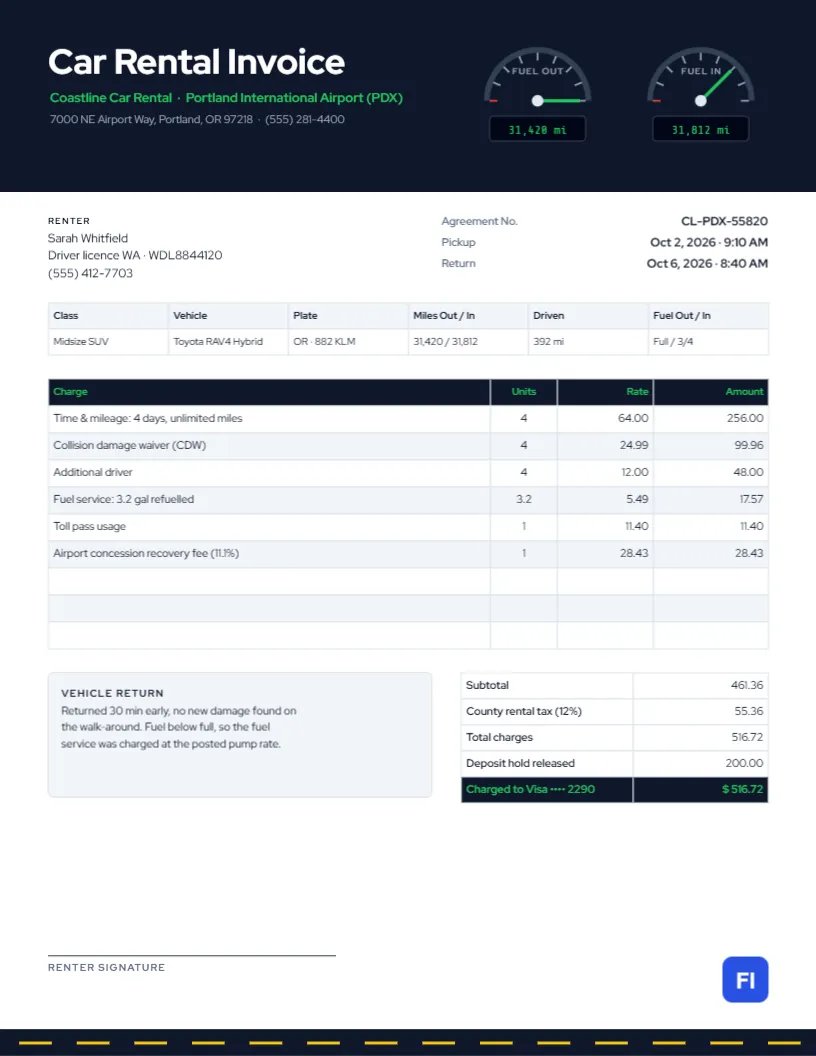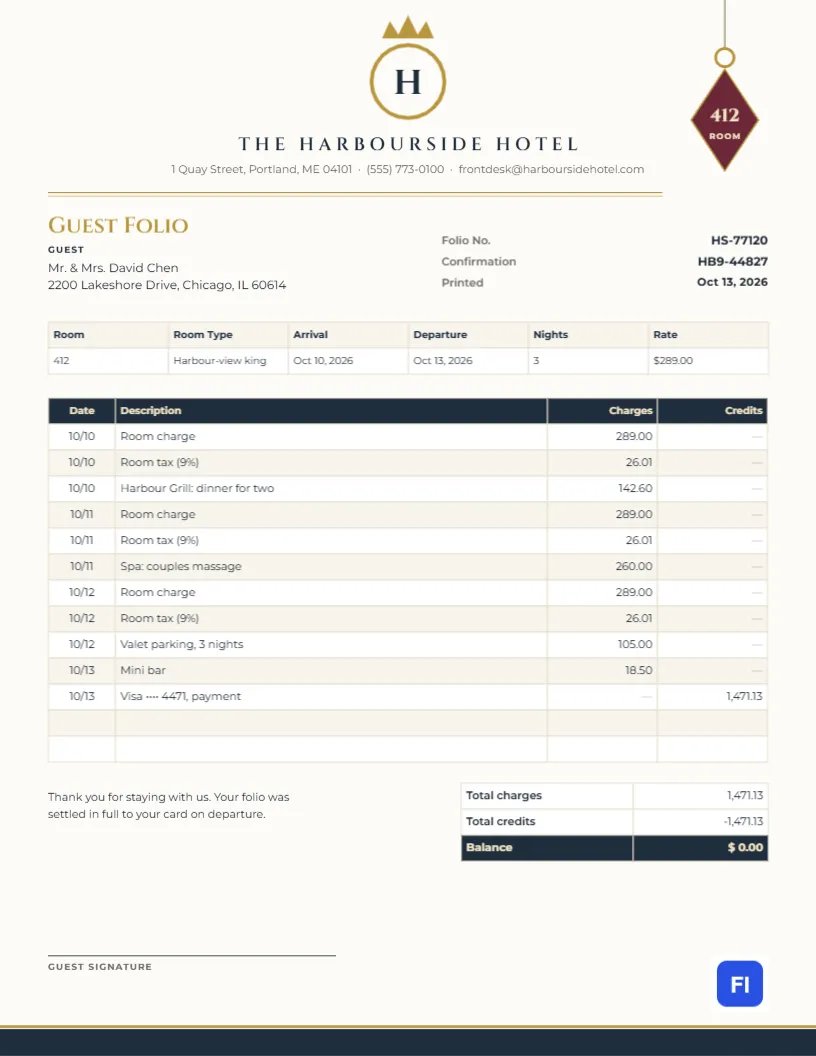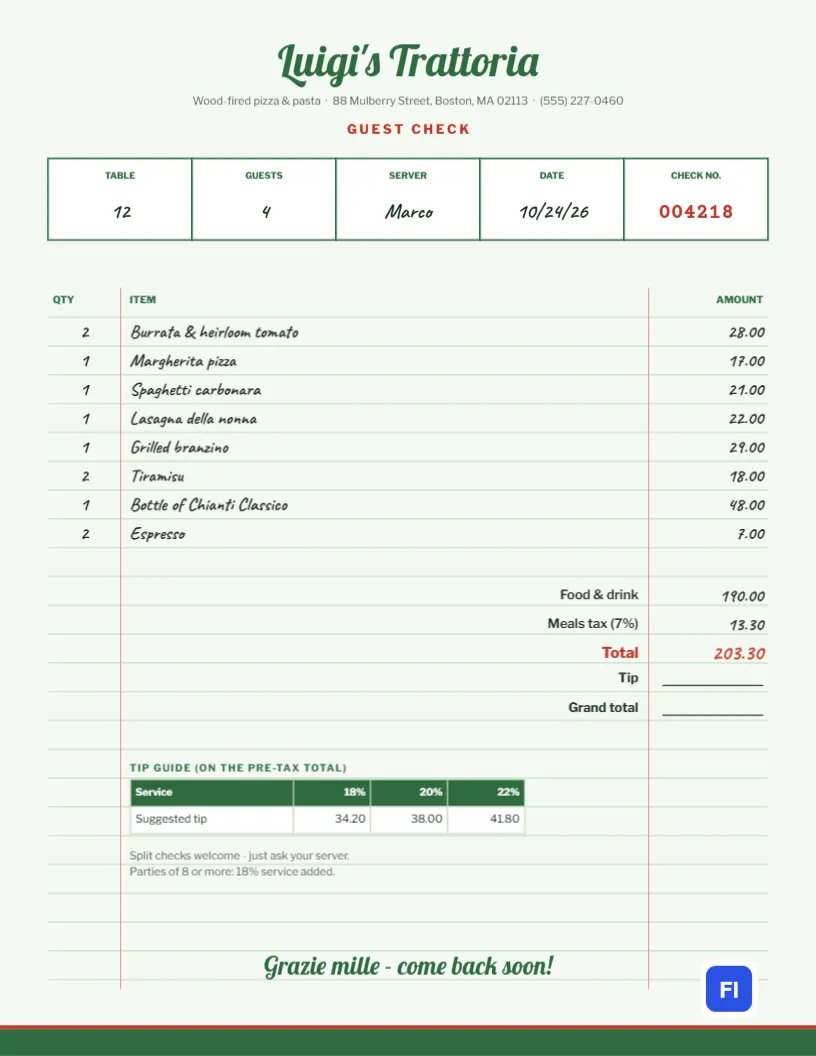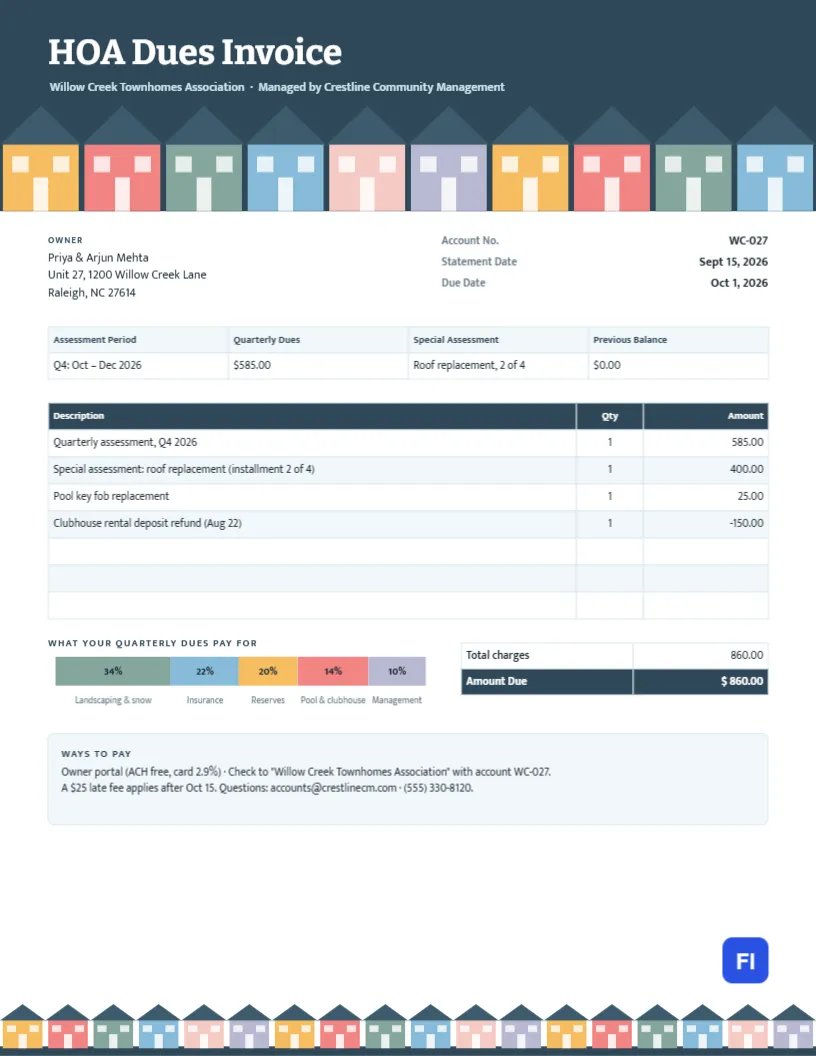
Homeowners associations bill their owners every month or quarter for dues that pay for landscaping, insurance, reserves, and shared amenities. Owners pay more willingly when they understand where the money goes, and special assessments, such as a roof replacement, need to be shown clearly on their own. This HOA Dues Invoice Template does that, with a row of pastel townhouses along the header and a color bar showing how quarterly dues are spent.
Homeowners Associations, Condos and Property Managers
It suits homeowners associations, condominium and townhouse associations, community management companies, cooperative housing boards, and neighborhood associations with voluntary dues. The sample shows Willow Creek Town-homes Association, managed by Crest-line Community Management, billing an owner for the fourth-quarter assessment, the second installment of a roof replacement special assessment, a replacement pool key fob, and a clubhouse deposit refund.
A Row of Townhouses
A deep slate header holds the title, HOA Dues Invoice in white Bitter, and the association and management company names. Along its bottom edge stand ten townhouses side by side, each with a dark gabled roof, a white door, and two windows, painted in soft yellow, coral, sage, sky blue, blush, and lavender. A smaller row of eighteen houses repeats along the footer, like a street seen from further away.
The owner block and account number, statement date, and due date follow. A strip records the assessment period, quarterly dues, special assessment, and previous balance. The charges table lists each item, and a stacked bar headed What your quarterly dues pay for splits the dues into landscaping and snow, insurance, reserves, pool and clubhouse, and management. Payment options run across the page beneath the totals.
Where the Dues Go
The budget bar gives owners a quick picture of the association’s spending. The sample shares are:
| Budget category | Share of dues | What it pays for |
|---|---|---|
| Landscaping & snow | 34% | Mowing, planting, snow removal on shared roads and walks |
| Insurance | 22% | Master policy for common areas and structures |
| Reserves | 20% | Savings for future roofs, paving, and major repairs |
| Pool & clubhouse | 14% | Maintenance, utilities, lifeguards |
| Management | 10% | Accounting, collections, vendor management |
Regular Dues vs Special Assessments
Regular dues fund the annual budget; a special assessment covers a one-off cost the reserves cannot cover, such as the roof replacement in the sample, often split into installments. Listing the special assessment separately, with installment 2 of 4, tells owners exactly how much is left and when it ends. In the sample, quarterly dues of $585, the roof installment of $400, a $25 key fob, and a $150 clubhouse deposit refund total $860.00.
Credits and Refunds
Refunds, such as a returned clubhouse deposit, are best shown as negative lines on the next invoice rather than paid separately, so the owner’s account stays in one place. Describe the credit clearly, with the date of the event it relates to.
Editing the Assessment Details and Charges
The assessment strip and charges table are editor tables. Double-click them or use Edit Table Data, and add or remove charges with + Add Row and – Remove Last. Amounts are typed values, so total the charges and credits yourself. The budget bar’s segments are rectangles whose widths you can adjust to your association’s own budget shares, with the percentages typed above them.
Late Fees and Collection Policies
Associations usually have a written collection policy setting the due date, a grace period, and late fees, and eventually liens for long-unpaid dues. The payment note in the sample states a $25 late fee after the 15th. Always follow your governing documents and state law, and apply the policy consistently to every owner.
Payment Options for Owners
Offer several ways to pay: an owner portal with free ACH, card payments with a small fee, and cheques with the account number written on them. The payment strip lists all three and gives an email and phone number for questions. Owners who can pay easily pay on time.
Recoloring the Townhouses
The townhouses are two groups, one in the header and one in the footer. Recolor the houses to match your community’s real facades, or use a single color for a more formal look. Slate and pastel suit a friendly neighborhood; navy and white suit a waterfront condo association.
Sending Statements Each Quarter
This statement is set up for US Letter paper. Email it to owners who have opted in and post it to the rest, ideally three weeks before the due date. Include a link to the annual budget and the latest board meeting minutes in the email; transparency builds trust.
Owners Who Rent Out Their Homes
Dues are the owner’s responsibility even when a tenant lives in the home. Send invoices to the owner’s mailing address, which may be different from the property address in the owner block, and note any tenant-related charges, such as amenity key fobs, clearly.
Buying and Selling Homes
When a home is sold, title companies request a statement of dues and assessments to settle them at closing. Keep each owner’s account current and be ready to issue a resale or estoppel statement showing dues paid, the special assessment balance, and any fees due.
Annual Budget Meetings and Dues Increases
Dues usually change once a year, after the board adopts a new budget. Give owners notice of the new amount before the first invoice that uses it, and say on the invoice which budget year the dues belong to. When an increase is needed, a clear explanation, such as higher insurance premiums or reserve study recommendations, helps owners accept it.
HOA Invoice FAQs
Can I bill monthly instead of quarterly?
Yes. Change the assessment period and amounts in the strip and charges table.
Can the invoice go to a property manager?
Yes, if the owner asks; keep the owner’s name on the account and add the manager’s address.
Can owners pay the special assessment early?
Many associations allow it; mention it in the payment note.
Are HOA dues tax deductible?
Generally not for a primary residence, but they may be for rental properties; owners should ask a tax adviser.