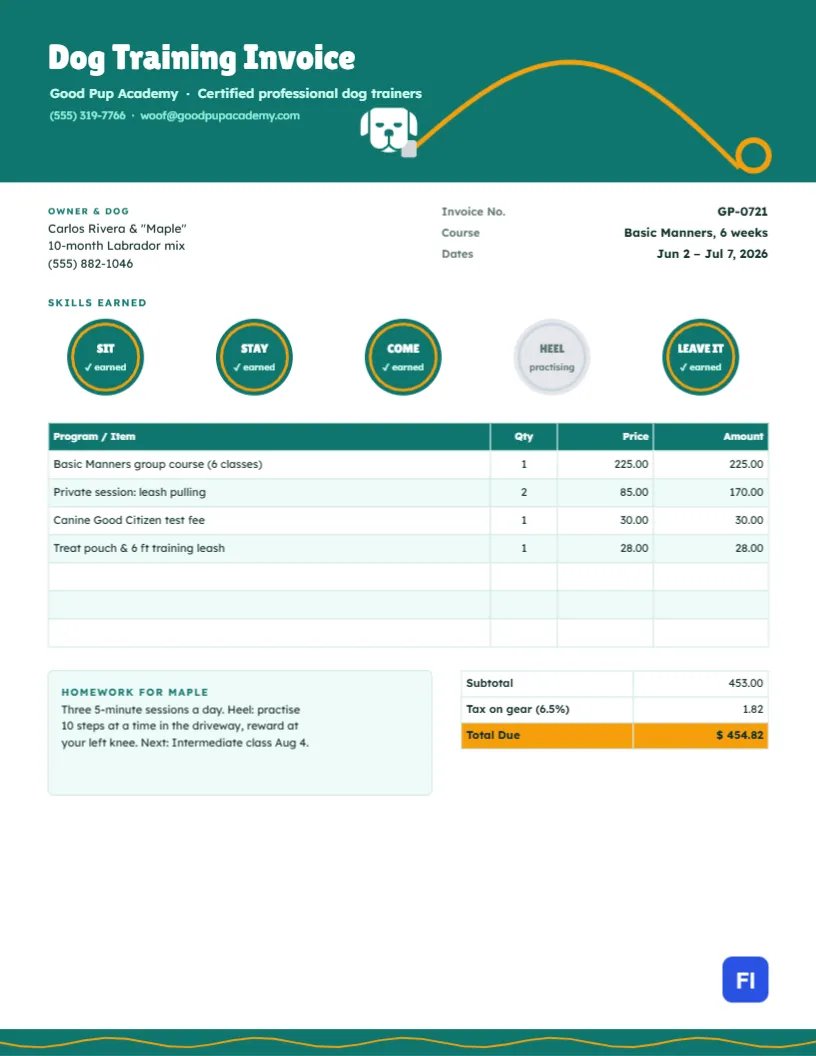
Dog owners pay for training because they want a calmer walk, a dog that comes when called, and fewer chewed shoes. The invoice is a chance to show them that progress, not just to ask for money. This Dog Training Invoice Template does that with a row of round skill badges- sit, stay, come, heel, and leave it- ticked as the dog earns them, under a teal header with an orange leash curving across it.
Dog Trainers, Training Schools and Behaviorists
It suits independent dog trainers, group class schools, board-and-train programs, puppy kindergarten classes, behavior consultants and pet stores that run training courses. The sample shows Good Pup Academy invoicing the owner of Maple, a ten-month Labrador mix, for a six-week basic manners course, two private sessions on leash pulling, a Canine Good Citizen test fee, and a treat pouch and training leash.
A Leash, a Dog and Five Badges
The teal header carries an orange leash that loops across the right side from a small silver clip beside a white dog face to a handle loop at the far end. Dog Training Invoice is set in Lilita One, a friendly, bold display font, with the school name and Certified professional dog trainers in pale mint. A wavy orange line runs through the teal footer, like a leash left on the floor.
The owner and dog block records the owner, the dog’s name, breed, age, and a phone number. The facts give the invoice number, course, and dates. Beneath them, five skill badges sit in a row: teal circles with orange rings and ✓ earned for skills mastered, gray circles with practicing for skills still in progress. The course and items table, homework, and the totals complete the page.
What the Skill Badges Mean
The badges turn the course goals into a simple report. In the sample, Maple has earned four of five:
| Skill | What “earned” means | Maple’s status |
|---|---|---|
| Sit | Sits on one cue, with distractions | Earned |
| Stay | Holds a stay for 30 seconds at 10 feet | Earned |
| Come | Recalls reliably in a fenced area | Earned |
| Heel | Walks at the handler’s side on a loose leash | Practising |
| Leave it | Ignores food dropped on the floor on cue | Earned |
Updating the Badges
Each badge is a circle, a ring, and two text labels. To mark a skill as earned, change its circle to teal, its ring to orange, and its label to ✓ earned; for a skill still in progress, use gray and practicing. Rename the skills for other courses, for example, Crate, Potty, and Name for puppy classes, or Loose leash and Place for intermediate training.
Course Fees and Extras
The six-class group course is $225, two private sessions on leash pulling are $170, the Canine Good Citizen test is $30, and a treat pouch and six-foot leash are $28, for $453.00. Sales tax at 6.5% applies only to the gear, $1.82, making $454.82. Training services are usually untaxed, but retail items are not.
Homework for the Owner
Most training happens at home between classes. The homework note gives the owner a clear plan: three five-minute sessions a day, heel practice ten steps at a time with a reward at the left knee, and the date of the next course. Owners who practice see results, and results are what bring them back for the next level.
Editing the Course Table
The course table and totals are editor tables. Double-click to change them, or open Edit Table Data, and add or remove items with + Add Row and – Remove Last. The amounts are typed values, so add up the course, sessions, and gear and calculate any tax yourself.
Group Classes, Private Sessions and Board-and-Train
Trainers often sell three formats: group classes for socialization and basics, private sessions for specific problems, and board-and-train, where the dog stays with the trainer for a week or more. List each format on its own line with its schedule. For board-and-train, add boarding days and a handover lesson so owners learn the cues their dog now knows.
Vaccination and Safety Requirements
Group classes usually require proof of vaccinations, such as rabies, distemper, and Bordetella. Mention your requirements on the booking form, and note on the invoice that records were received. It reassures other owners and protects the dogs in class.
Recoloring the Leash and Badges
The leash, clip, and handle form one group; recolor them to match your brand, perhaps red on navy or pink on charcoal. The dog face is an editable vector, and you can swap it for a paw, a bone, or a ball from the library. Keep the earned badges in a strong color so progress stands out.
Sending the Invoice After the Last Class
This template fits US Letter paper. Many trainers send the invoice with a short progress report after the final class, and owners often stick the badge row on the fridge. Print a copy for graduation day; it makes a nice certificate-style keepsake.
Behaviour Consultations
For reactivity, anxiety, or aggression, trainers and behavior consultants usually start with a longer consultation and a written plan, then follow-up sessions. Bill the consultation and plan as one line and each follow-up separately. Keep the notes factual and kind, since owners of reactive dogs often feel judged.
Graduation and the Next Level
Finishing a course is a proud moment for owners. Many schools hold a short graduation at the last class and hand out a certificate; the badge row on this invoice can serve the same purpose. Use the homework note to invite the owner to the next level, such as intermediate manners, trick training, or a Canine Good Citizen test, with a start date. Owners who move straight on to the next course keep practicing and keep their dog’s progress going.
Dog Training Invoice FAQs
Can I use this for puppy classes?
Yes. Rename the badges for puppy skills and list the class dates in the course line.
Should I offer refunds for missed classes?
Many schools offer a make-up class instead; state your policy when owners enroll.
Can I bill a package of private sessions?
Yes. Add the package as one line and note how many sessions remain.