Alterations are personal. A customer brings in a suit for a wedding, trousers that need hemming, or a favorite coat with a torn lining, and trusts you to get every measurement right. The ticket or invoice is where those measurements, the work agreed, and the pickup date are written down. This Tailoring and Alterations Invoice Template turns that ticket into a refined document, with a measuring tape running down the left edge and a stitched border around the page.
Tailors, Seamstresses and Alteration Shops
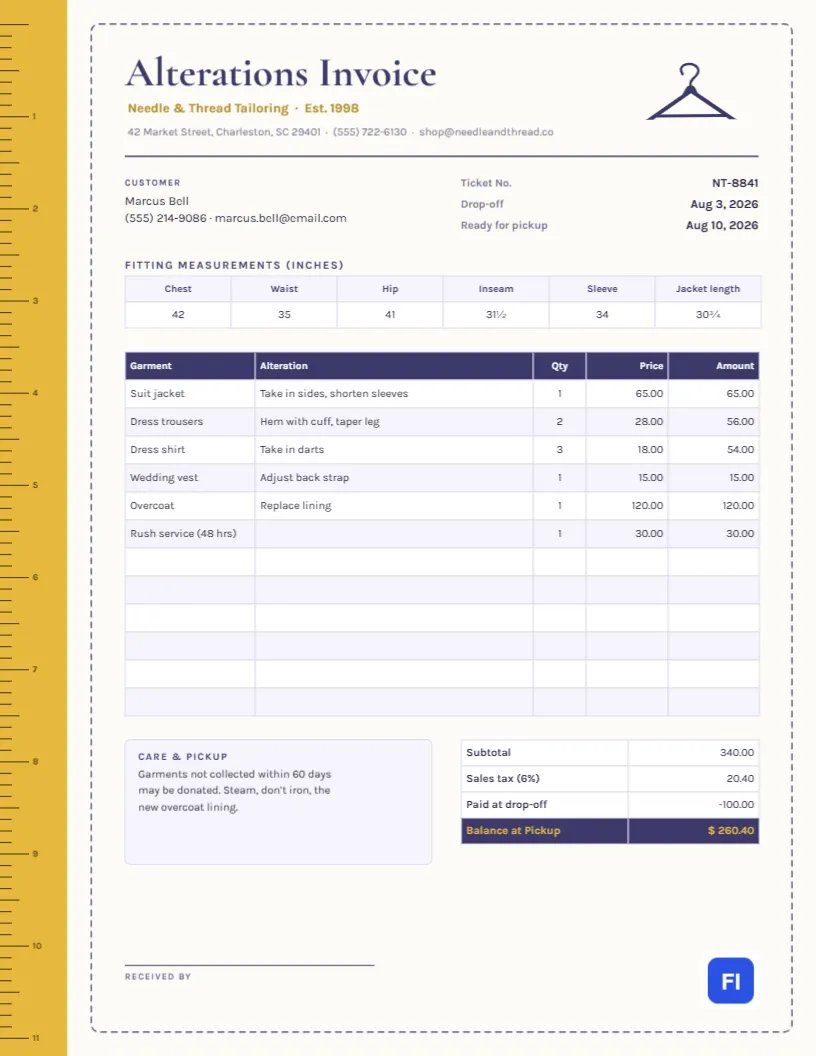
It suits alteration shops, bespoke and made-to-measure tailors, seamstresses working from home, bridal alteration specialists, dry cleaners that offer repairs, and costume makers. The sample shows Needle & Thread Tailoring invoicing Marcus Bell for a suit jacket taken in with shortened sleeves, two pairs of dress trousers hemmed and tapered, three dress shirts with darts, a wedding vest adjustment, a replacement overcoat lining, and rush service.
A Tape Measure and a Line of Stitches
Down the entire left edge of the page runs a golden-yellow measuring tape, marked with fine tick marks and numbered from one to eleven, just like the tape draped around every tailor’s neck. The rest of the page is framed by a dashed navy line, like a row of hand stitches holding the document together. In the top-right corner, a navy coat hanger hangs above the header.
Alterations Invoice is set in elegant navy Cormorant Garamond, with the shop name and Est. 1998 in gold and the address, phone, and email underneath, over a fine navy rule. The customer block sits beside the ticket number, drop-off date, and ready-for-pickup date. A six-column strip records fitting measurements: chest, waist, hip, inseam, sleeve, and jacket length. The garment table follows, then a lavender Care & pickup note, the totals (ending in a navy-and-gold Balance at Pickup), and a Received by signature line.
A Price Guide for Common Alterations
Customers often ask for a price before handing over their clothes. A simple list, kept consistent with what you invoice, makes the conversation easy. Example prices:
| Alteration | Typical Price |
|---|---|
| Trouser hem, plain | $15-$20 |
| Trouser hem with cuff, taper leg | $25-$35 |
| Jacket sleeves shortened | $30-$45 |
| Jacket taken in at sides | $35-$50 |
| Replace coat lining | $100-$160 |
| Zipper replacement | $15-$30 |
The sample’s six lines come to $340.00; with 6% tax ($20.40) and $100 paid at drop-off, $260.40 is due at pickup.
Recording Measurements Accurately
The measurement strip is what makes this invoice useful beyond billing. Record the measurements you pinned or agreed on, in inches or centimeters, with fractions where needed (the sample includes 31½ and 30¾). If the customer comes back for another garment, or if a fitting needs to be repeated, you already have their numbers. Change the headings to suit the garment: bust and hip for a gown, rise and thigh for trousers.
Describing Each Alteration
The garment table separates the garment from the work done, so the customer can see exactly what was changed: Suit jacket and take in sides, shorten sleeves. Listing each piece separately helps at pickup, when the customer checks that everything has come back, and helps you if a question arises about one item later.
Editing the Table and Totals
The measurement strip, garment table, and totals are editor tables. Double-click to type into them or use Edit Table Data, with + Add Row for more garments and – Remove Last to remove unused rows. The text in each cell is fixed, not calculated, so work out each amount, the subtotal, tax, deposit, and balance yourself.
Rush Orders and Fittings
Rush service, like the 48-hour line in the sample, deserves its own row so the customer sees the premium. If a second fitting is needed, note the date in the Care & pickup box. For bridal work with several fittings, list each fitting and its date so the customer can follow the schedule.
Changing the Tape, Border and Hanger
The measuring tape is a group of shapes, and its numbers are plain text, so you can recolor the tape (white and black tapes are common too) or change the numbering to centimeters. The dashed border is a single rectangle; change its color or dash pattern in the object settings. The hanger is an editable vector that can be swapped for scissors, a needle and thread, or a sewing machine from the library.
Printing a Ticket and a Customer Copy
The page is US Letter, 8.5 by 11 inches. Many shops print two copies at drop-off, one pinned to the garment bag and one for the customer, then use the same invoice at pickup. Plain white paper works well; the golden tape prints warm and bright on most printers.
Unclaimed Garments
Every alteration shop has a rack of garments that were never collected. State your policy clearly on the invoice, as the sample does: garments not collected within sixty days may be donated. Check local rules for how long you must keep items and how customers must be notified, then apply the policy consistently.
Custom Garments and Deposits
For made-to-measure suits, dresses, or costumes, the invoice becomes a record of fabric choices and design details as well as measurements. Add the fabric, lining and buttons to the garment description, take a larger deposit to cover materials, and bill the balance at the final fitting. The measurement strip then becomes the customer’s pattern record for future orders.
Bridal and Formal Wear Seasons
Spring and early summer bring a rush of wedding gowns, bridesmaid dresses, and suits, often with tight deadlines. Book fittings early, write each fitting date on the invoice, and ask for a deposit on complex work like bustles or beading. When several garments from one wedding party come in together, one invoice per person keeps payment simple even if the bride or groom is coordinating the whole group.
Alterations Invoice FAQs
Can I use centimeters?
Yes. Change the heading of the strip to Fitting measurements (cm) and enter your values.
Should I charge tax on alterations?
Some places tax alteration services and some do not; check the rules where your shop operates.
How do I show a free adjustment?
Add the item with a price of 0.00 and a note, so the customer sees the goodwill.